
Atmospheric air contains water vapour in the form of invisible droplets. The amount depends on the pressure and temperature of the air. Changes to pressure have a negligible effect, while temperature has a significant impact. As the temperature rises, the air’s capacity to retain water vapour increases, and vice versa. The vapour content of the air is measured either in absolute or in relative values.
- Absolute humidity is the amount of vapour in the air at a given temperature expressed in g/m3.
- Relative humidity is the ratio of the amount of vapour at a given temperature to the maximum possible amount of vapour retained in the same volume of air and at the same temperature.
φ=C/CS x 100 (%)
- φ = relative humidity
- C = the concentration of vapour molecules contained in the air at a given temperature.
- CS = the concentration of molecules in saturation at the same volume of air and the same temperature
How does condensation work?
When the vapour in the atmosphere reaches saturation, any excessive vapour is condensed and settles on the surfaces of the structural elements as droplets. This concentrated amount of moisture is the dew, while the temperature at which the phenomenon occurs is called the dew point or dew temperature.
When the hot air in a room comes in contact with a cold surface, such as a conventional window, it loses some of its heat and cools down. As its temperature decreases, its ability to retain a quantity of vapour (Cs) decreases.

If the air’s temperature drops below the dew point, then surface condensation is observed. In the above diagram, we see that if the air temperature drops from 20ο C to 10ο C, a quantity of humidity of 7.9g /m3 will be released.
Condensation can also occur if the relative humidity of the room increases, which happens in areas with many people due to breathing, boiling water in the kitchen or a bathroom when using hot water.
When does condensation appear?
Condensation usually occurs during the winter, when the outside temperature drops to low levels and at points that appear to be the coldest, generally the windows. Below is a table with the maximum surface temperatures where liquefaction is appearing.
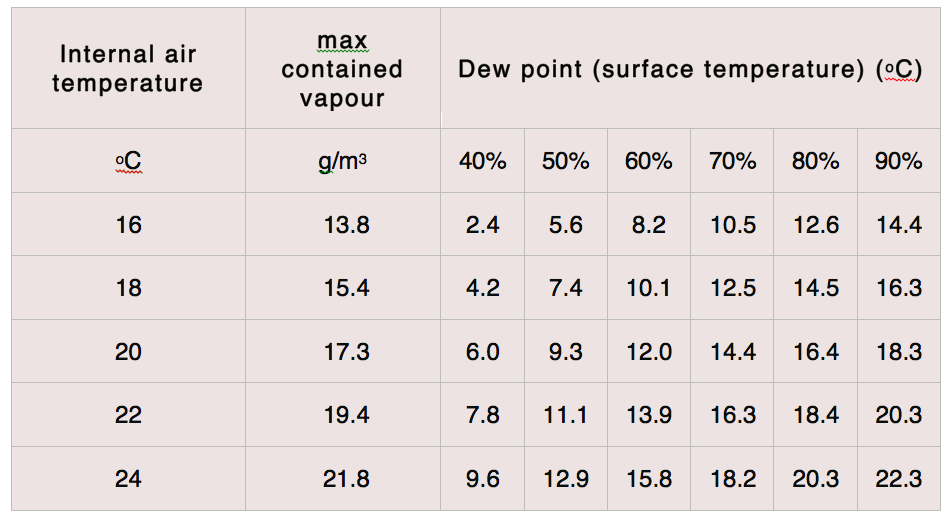
Observing the above table, we see that for an indoor air temperature of 20oC and relative humidity of 60%, condensation will occur in any element with a temperature below 12oC.
An energy-efficient window with a lower coefficient of thermal permeability (more thermal insulation) has a higher temperature on its inner surface than a conventional one, a fact shown in the following table.
At an external temperature of -11o C and indoor at 20o C, the conventional window has a temperature of 5oC on its inner surface while the energy efficient one has 12o C. Therefore the first will show condensation at a relative humidity of 40%, while the latter will show if relative humidity exceeds 60%.
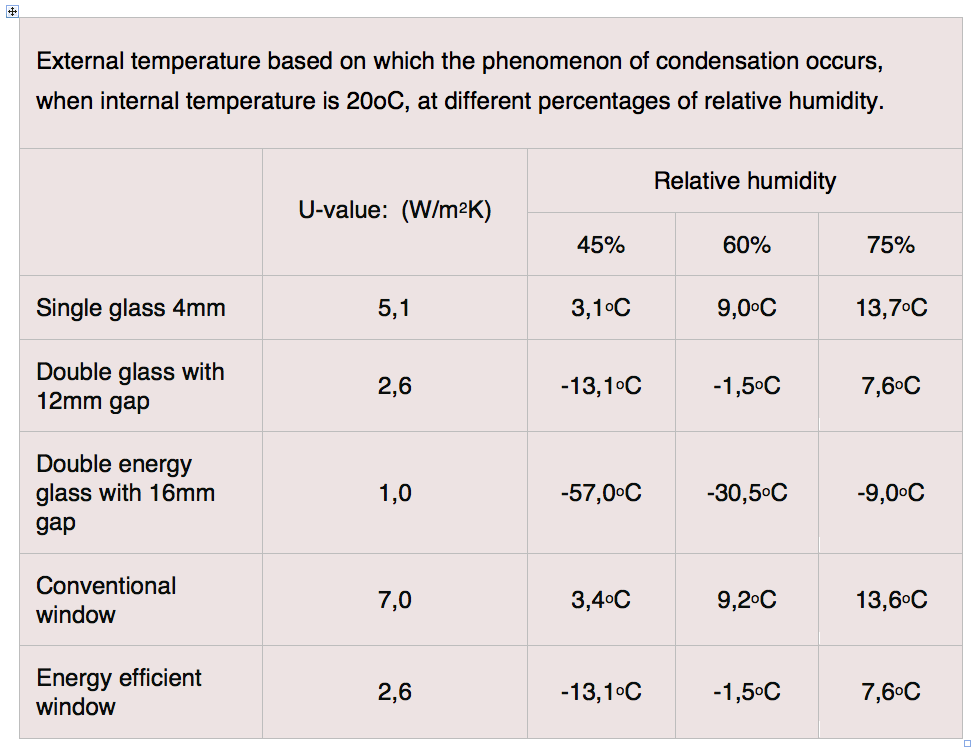
We see that with an indoor air temperature of 20oC and relative humidity of 60%, condensation will occur on a conventional window when the external temperature drops below 9.2o C. In the case of a thermal break frame, this limit drops to -1.5o C.
A thermal break aluminium window with a single 4mm glass is no good either: there will be no condensation on the frame, but there will be droplets on the glass when the external temperature falls below 9.0o C.
IMPACTS
- Humidity harms homes and human health.
- Infects and destroys building materials due to absorption.
- Reduces the thermal insulation capacity of the structural elements.
- Favors the growth of bacteria and the retention of microorganisms in the materials, especially when accompanied by high temperatures.
- Creates a feeling of discomfort in people living or working in a humid place.
- Creates an unsightly image in the space (mould).
Condensation is distinguished from other forms of moisture by the way it appears:
- It is usually a temporary and periodic phenomenon.
- The infestation does not go deep into the building block, but remains superficial.
- It is an interior phenomenon, so it appears only on the inner surface of the house.




 NZEB Energy Rating