
Human thermal comfort

Humans are comfortable only within a very narrow range of conditions. Our body temperature is about 37°C, despite the fact that the body generates heat even while at rest: we must lose heat at the same rate it is produced and gain heat at the same rate it is lost. The diagram below shows the various ways by which our bodies achieve this.
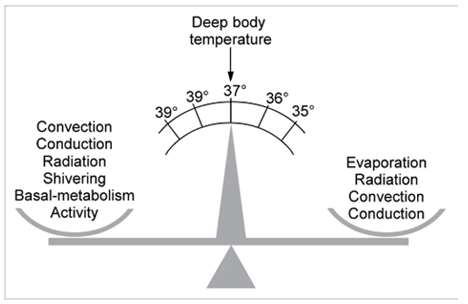
The main factors influencing both physical and psychological human comfort are temperature, humidity, air movement, exposure to radiant heat sources and exposure to cool surfaces to radiate, or conduct to, for cooling.

Thermal simulation software can model with great accuracy the amount of heating or cooling energy required to achieve physiological comfort; it is unable to model highly variable human perceptions of comfort. Sound building envelope design based on modelling delivers an environment that addresses all the physical factors necessary for comfort (except humidity) but can’t always meet our psychological comfort needs.

Important triggers for psychological discomfort are radiation, air movement and conduction. Although they are less effective physiologically, they trigger innate self-preservation responses that override our ability to perceive physical comfort. Until they are met, we don’t feel thermally comfortable and our behaviour can render the best of design solutions ineffective. Acclimatisation is a critical component of psychological comfort.

Psychological thermal discomfort can make us set the thermostat on heating or cooling systems well beyond levels required for comfort. For every 1°C change in thermostat setting, it is estimated that our heating or cooling bill rises by around 10%. In other words, failure to address psychological comfort can increase heating and cooling energy use by up to 50% (Australian Greenhouse Office 2005).

Losing body heat

We lose heat in three ways: through evaporation, radiation and conduction.

Our most effective cooling method is the evaporation of perspiration. High humidity levels reduce evaporation rates. When relative humidity exceeds 60%, our ability to cool is greatly reduced. Evaporation rates are influenced by air movement. Generally, a breeze of 0.5 m per second provides a one-off comfort benefit equivalent to a 3°C temperature reduction.

We also lose heat by radiating to surfaces cooler than our body temperature, such as tiled concrete floors cooled by night breezes or earth coupling. The greater the temperature difference, the more we radiate. While not our main means of losing heat, radiation rates are very important to our psychological perception of comfort.

A third way to lose heat is conduction, i.e. through body contact with cooler surfaces such as when going for a swim or sleeping on an unheated waterbed. Conduction is most effective when we are inactive (e.g. sleeping) and is a particularly important component of psychological comfort.

Gaining body heat

When the heat produced by our bodies is insufficient to maintain body temperature, we shiver. This generates body heat and has a short-term physiological effect but also triggers our deepest psychological discomfort warning mechanisms. Our first response is generally to insulate ourselves by putting on more clothes and sheltering from wind and draughts. These actions are effective because we generate most of the heat we require from within, and reducing heat loss makes body heat more effective. Our minds quickly decide whether the adjustment is adequate for thermal comfort.

A secondary source of heat gain is radiation. As with cooling, radiation is very important to our perception of comfort. For example, we can feel cold in a room that is a comfortable 22°C if there is a cold window nearby; conversely, we can feel warm at 0°C if we are well insulated with warm clothing and standing in the sun.

The final source of heat gain is conduction. Simply holding someone’s hand can create psychological thermal comfort though a small amount of conduction. We conduct to cool floors and from heated floors. Heated floors also provide radiant heat and raise air temperatures through conduction and convection.
Energy Rating Certificates

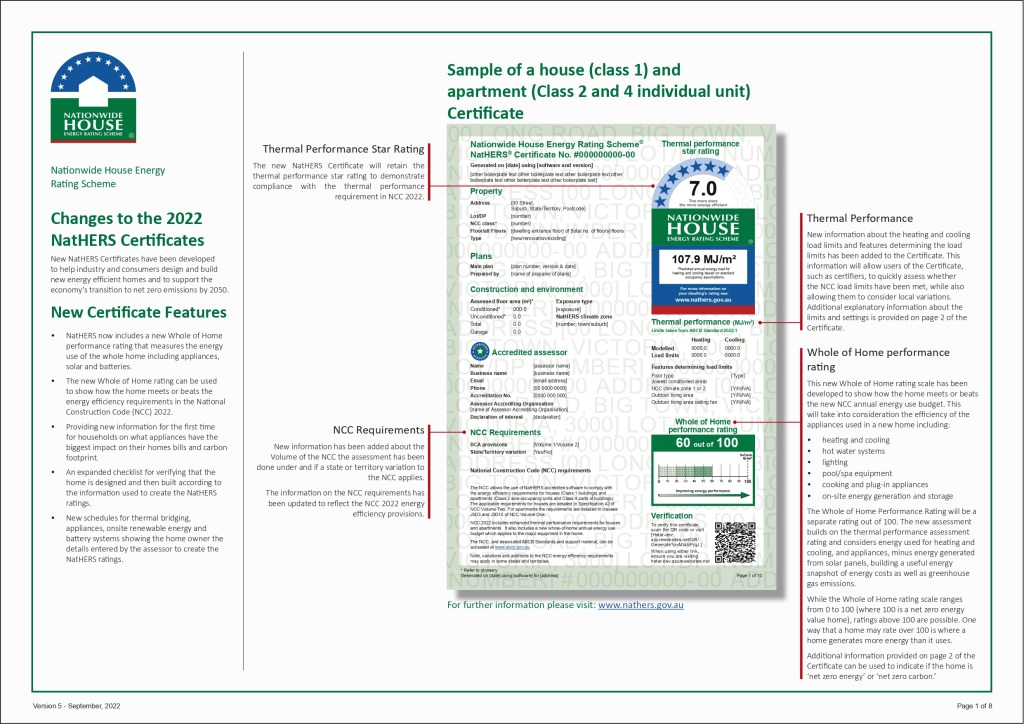
A NatHERS Certificate allows builders, certifiers and regulatory authorities to quickly confirm that a building has been built to the design on which the energy rating is based. 

During the National Construction Code 2022 transition period (1 October 2022 to 30 September 2023), the 2019 version of the NatHERS Certificate can be used to demonstrate compliance with National Construction Code 2019.

New 2022 NatHERS Certificates include additional information to support the changes to residential energy efficiency in the National Construction Code (NCC) 2022.

The certificates also provide new information for households on the greenhouse gas emissions of a home, the costs and energy used by major appliances, and the impact of solar and batteries. This aims to help consumers understand what appliances have the biggest impact on their bills and carbon footprint.

The new Certificate will continue to display a ‘thermal’ star rating out of 10. This is based on how much heating and cooling is needed to keep a home comfortable.

The new ‘Whole of Home’ rating is out of 100. This is based on energy use for the home’s appliances (heating and cooling systems, hot water heaters, lighting, pool pumps and spas) and solar panels and batteries.

The rating considers energy used for heating and cooling, and appliances, minus energy generated from solar panels. Ratings above 100 are possible (100 is considered a net zero energy value home). One way that a home may rate over 100 is where the home generates more energy than it uses.

Where a Whole of Home assessment has not been undertaken, this will be specified on the certificate.

These changes will help householders understand their home’s overall energy performance, helping them improve the comfort of their home, while reducing energy bills.

Australian homes are colder in winter than houses in Greenland

Australian homes are colder in winter than those in cool-climate European countries such as Finland and Greenland, a new study has found.

The “Cold homes in Australia” study, which was conducted by the Australian Centre for Housing Research, found that houses in temperate climates across New South Wales, Victoria, South Australia, Western Australia and Tasmania averaged temperatures well below 18 °C: the World Health Organization’s recommended minimum.

In the study’s sample of 100 homes, the average wintertime temperature was 16.5 °C. Victoria and Tasmania recorded the lowest averages at 15.7 °C and 15.8 °C respectively (though the differences between states were not statistically significant). “This Australian attitude of winter stoicism – also observed among New Zealand households – has led to the construction of homes that give little consideration to winter conditions.”

By way of comparison, wintertime indoor temperatures in Finland are typically between 20 °C and 24 °C, while the average in Greenland is 21.8 °C.

Although Australian excess winter deaths are high compared to European countries, many Australians “ignore” winter, believing it to be short and pleasant compared to other countries, the study found.

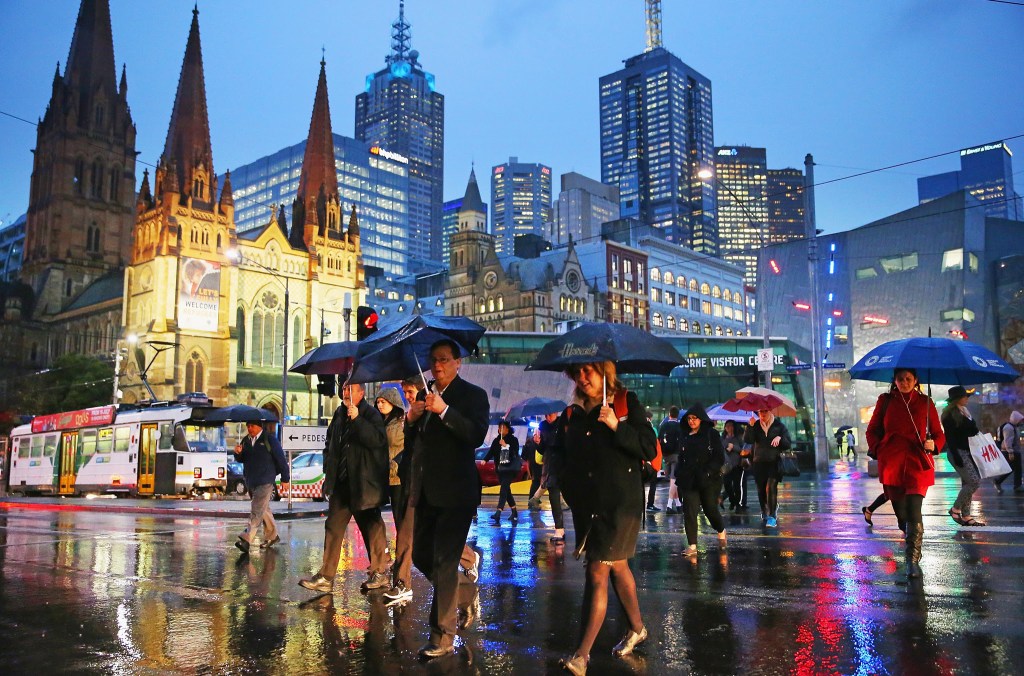
MELBOURNE, AUSTRALIA – JULY 31: (Photo by Scott Barbour/Getty Images)

Australia’s cold housing problem has long been known, yet the study authors said estimates currently used to model the impact of wintertime cold are “unlikely to reflect the true extent of the problem.”

In 2015, a study published in The Lancet found that due to poor-quality housing, Australians were twice as likely as Swedes to die of cold.

On top of health implications, Australia’s leaky housing causes high energy bills. Philip Oldfield wrote in Architecture Australia that Australians struggle with a legacy of poorly performing houses because “we have been slower in acting to improve energy efficiency than many other developed nations.”

For instance, while many Western European countries implemented insulation requirements in the 1980s, this wasn’t done in Victoria until 1991 – and it wasn’t until 2003 that the Building Code of Australia set minimum energy efficiency standards for housing.

“The poor quality of our housing is having a detrimental impact on both people and planet,” said Oldfield, who advocated retrofits to make existing housing stock more energy efficient.

“Upgrading and refurbishing these buildings, rather than demolishing them, will save energy, materials, waste and carbon emissions. This will not only contribute to our fight against the climate crisis but also improve the health, well-being and security of millions of householders across the country,” Oldfield said.

(Article published at Architecture Australia: http://www.architectureau.com)