
Europe’s big push for Zero Carbon buildings

What is changing and why it matters

If you live, work, or invest in property in Europe, big changes are on the horizon. The European Parliament has just approved a sweeping set of rules to make buildings more energy-efficient, cut greenhouse gas emissions, and lower energy costs — all while helping fight climate change.

And the clock is ticking: by 2030, all new buildings in the EU must produce zero carbon emissions.

Why the Focus on Buildings?

Buildings are one of the EU’s biggest environmental challenges, responsible for about 36% of greenhouse gas emissions. They consume massive amounts of energy, not just for heating and cooling, but across their entire lifecycle — from construction to demolition.

The new rules aim to fix that by:
– Slashing energy use in the building sector by 2030.
– Making the entire sector climate-neutral by 2050.
– Renovating older, inefficient buildings to modern standards.
– Providing better, clearer energy performance information.

Key Targets You Need to Know

1. Zero-Carbon Deadline
All new buildings: Zero greenhouse gas emissions by 2030.
Public sector buildings: Even earlier — by 2028.

2. Renovations for the Worst Performers
By 2030, 16% of the worst-performing non-residential buildings must be renovated.
By 2033, this rises to 26%.

3. Solar Energy Requirements
From 2030, all new homes must include solar energy technology.
Public and commercial buildings will also need solar, if technically and economically feasible.

4. Residential Energy Savings
Countries must cut average primary energy use in homes by at least 16% by 2030, and 20–22% by 2035.

Goodbye to Fossil Fuel Boilers

The EU is also taking aim at heating systems:
– Fossil fuel boilers will be completely banned by 2040.
– From 2025, no subsidies for standalone fossil fuel boilers.
– Hybrid systems using renewable energy — like those combining solar thermal with a boiler or a heat pump — will still qualify for incentives.

Who’s Exempt?

Not every building will need to follow the rules. Agricultural buildings, cultural heritage sites, and protected architectural landmarks can be exempt. The same goes for certain temporary structures, churches, and places of worship.

What This Means for Europeans

If someone is planning to build, renovate, or invest in property within the EU, these changes will reshape how projects are designed, built, and powered. Expect greater emphasis on:
– Sustainable construction materials.
– Renewable energy integration.
– Long-term energy efficiency.

While the deadlines may seem far away, the time to adapt is now — not just to meet regulations, but to benefit from lower energy bills and future-proofed investments.

Bottom line: Europe’s zero-carbon building push isn’t just an environmental policy — it’s a massive transformation of how we live and work. And it’s one that could set the tone for building standards worldwide.
NCC 2025 proposed changes

The next edition of the National Construction Code proposes amendments. These amendments focus on the requirements for energy efficiency of commercial buildings. It includes waterproofing of balconies, car parks, storage and warehouses. Additionally, it focuses on condensation management. If approved, these changes will affect construction costs for houses and apartments. They will also impact construction techniques and the acceptability of standard building materials.

What are the major changes being proposed for commercial Class 3 & 5-9 buildings?

Significant energy efficiency stringency increases for Commercial building Class 3, 5-9 buildings are a focus of the 2025 amendment. These include:
– Air-conditioning system efficiency, and ducting length restrictions
– Requirements for building sealing
– Insulation
– Solar remittance and solar reflectance of roof materials in place of solar absorptance
– Glazing
– Space heating
– Artificial lighting demand control
– Pump and fan efficiency
– Energy efficiency modeling verification techniques have changed. These methods now align with stringency increases for elemental provisions.

Electrification is a focus of the proposals, which will need:
– That physical space and spare electrical capacity be provided for equivalent electrical appliances in future where gas appliances are installed.
– Provision for future battery installations.
– Varying levels of Solar Photovoltaic arrays (or equivalent) based on climate zone, class, floor area and presence of gas appliances.
– Electric vehicle charging equipment quantified to be enough for 20% of the daily driving needs. This applies to all occupants of a Class 3, Class 5-9 building..
– Increased fire safety for car parks (including open deck car parks) to mitigate fire risks linked to modern vehicles and car stackers.

Condensation and mould

The average person feels comfortable with an internal temperature of 22-25 degrees in winter. The colder the external temperature is, the higher the temperature difference is. Condensation appears when warm air contacts a cold surface. It is the same phenomenon when droplets appear on a glass of cold water in summer, and it is the same reason causing rain. Mould builds up when condensation is combined with poor ventilation and air movement.

Thermal bridges

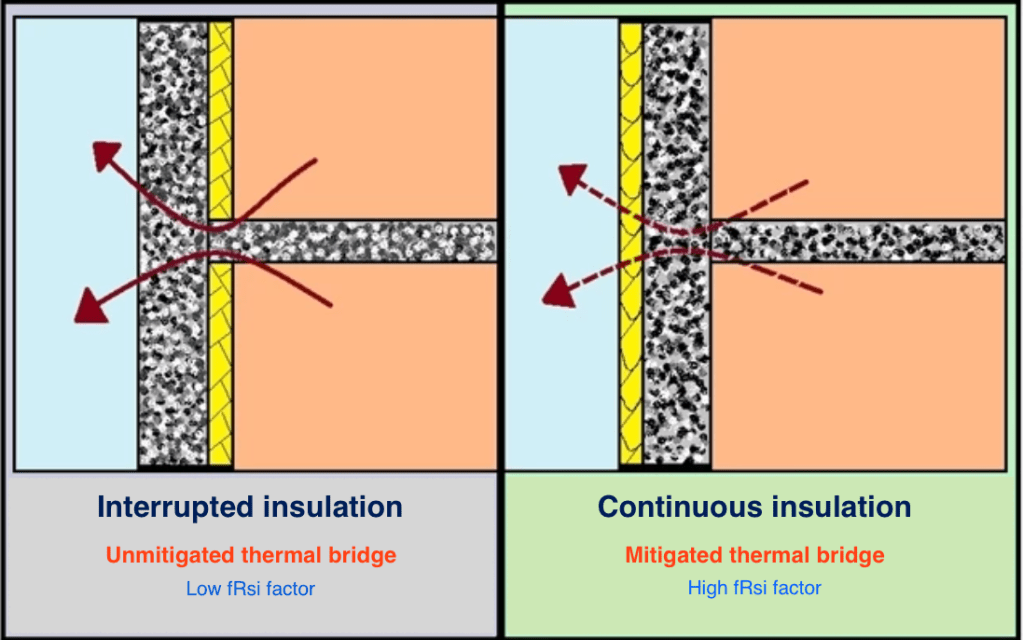
The decisive factor describing the thermal “strength” of areas with discontinuity in the thermal envelope, also known as the “thermal bridge”, is the fRsi value. The thermal envelope needs to be as homogeneous as possible so that the internal temperature can be even over the entire space. To achieve this, we must design the thermal bridges by considering the heat flow.

The fRsi factor

The combination of the thermal envelope and the heating or cooling system determines the average room temperature. Because of discontinuities of the envelope, the surface temperature in the “weakest” spots will always be lower than any “average” temperature. This is caused by the fRsi factor of the thermal bridge.

The fRsi factor is the difference between the internal temperature at the thermal bridge minus the external temperature, divided by the average temperature difference between the inside and outside:

fRsi = (T thermal bridge – T ext) / (T int – T ext)

The difference between the internal and the external temperature is easy to find. The internal temperature at the thermal bridge, however, requires a calculation based on its geometry and materials. The fRsi factor is a number ranging from one to zero. It is 1 when the temperature at the thermal bridge is the same as in the rest of the building and is 0 when it is identical to the external one. Both are physically impossible to achieve therefore, we try to get values close to 1.

How is mould created?

A surface temperature that is lower than the average negatively affects the thermal comfort of the building. This asymmetry makes us feel that a room is “cold” or “warmer” in summer, even though the average temperature may be higher. High humidity caused by lack of ventilation fosters the appearance of condensation and mould where the fRsi factor is at its lowest. To avoid such phenomena, any work done on the thermal envelope should include a thorough analysis of the fRsi factors.

When we design the treatment of a thermal bridge, we compare the “strength” of different solutions by comparing their fRsi values. As shown in the graph, the unmitigated solution is fostering mould growth even with mild outside temperatures.

Conclusions

For a healthy indoor environment, we must design the thermal bridges of the thermal envelope in a way that internal surface temperatures are high enough to avoid the risk of mould and condensation.

As a reference, the Passive House standard requires a minimum fRsi factor of 0.65 in “warm-temperate” climate zones like in Melbourne, a 0.70 for “cool-temperate” and 0.75 for “cold climate zones”.