
The average person feels comfortable with an internal temperature of 22-25 degrees in winter. The colder the external temperature is, the higher the temperature difference is. Condensation appears when warm air contacts a cold surface. It is the same phenomenon when droplets appear on a glass of cold water in summer, and it is the same reason causing rain. Mould builds up when condensation is combined with poor ventilation and air movement.
Thermal bridges
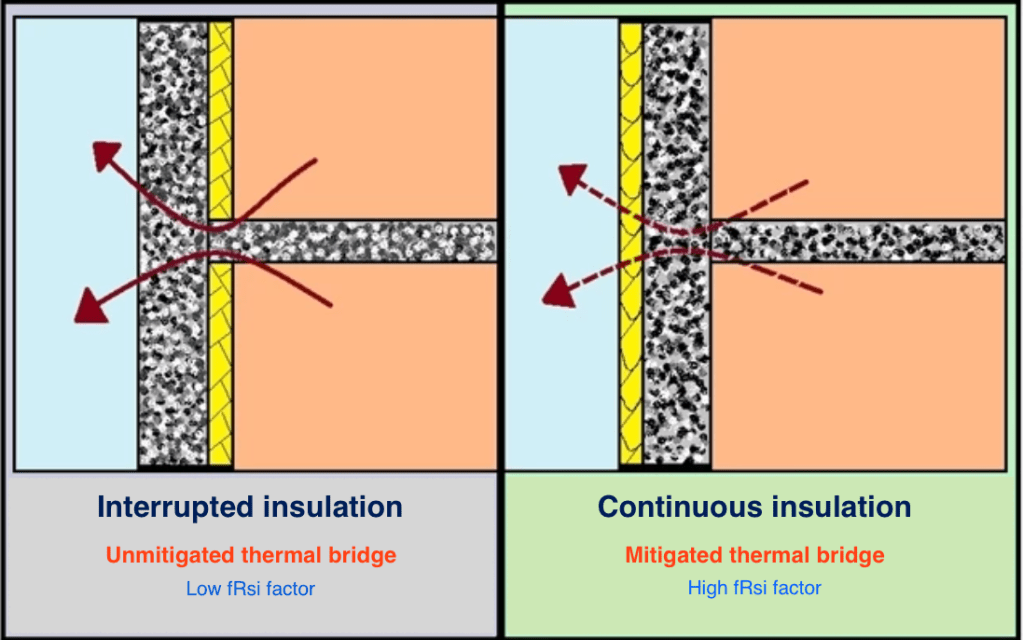
The decisive factor describing the thermal “strength” of areas with discontinuity in the thermal envelope, also known as the “thermal bridge”, is the fRsi value. The thermal envelope needs to be as homogeneous as possible so that the internal temperature can be even over the entire space. To achieve this, we must design the thermal bridges by considering the heat flow.
The fRsi factor
The combination of the thermal envelope and the heating or cooling system determines the average room temperature. Because of discontinuities of the envelope, the surface temperature in the “weakest” spots will always be lower than any “average” temperature. This is caused by the fRsi factor of the thermal bridge.
The fRsi factor is the difference between the internal temperature at the thermal bridge minus the external temperature, divided by the average temperature difference between the inside and outside:
fRsi = (T thermal bridge – T ext) / (T int – T ext)
The difference between the internal and the external temperature is easy to find. The internal temperature at the thermal bridge, however, requires a calculation based on its geometry and materials. The fRsi factor is a number ranging from one to zero. It is 1 when the temperature at the thermal bridge is the same as in the rest of the building and is 0 when it is identical to the external one. Both are physically impossible to achieve therefore, we try to get values close to 1.
How is mould created?
A surface temperature that is lower than the average negatively affects the thermal comfort of the building. This asymmetry makes us feel that a room is “cold” or “warmer” in summer, even though the average temperature may be higher. High humidity caused by lack of ventilation fosters the appearance of condensation and mould where the fRsi factor is at its lowest. To avoid such phenomena, any work done on the thermal envelope should include a thorough analysis of the fRsi factors.
When we design the treatment of a thermal bridge, we compare the “strength” of different solutions by comparing their fRsi values. As shown in the graph, the unmitigated solution is fostering mould growth even with mild outside temperatures.
Conclusions
For a healthy indoor environment, we must design the thermal bridges of the thermal envelope in a way that internal surface temperatures are high enough to avoid the risk of mould and condensation.
As a reference, the Passive House standard requires a minimum fRsi factor of 0.65 in “warm-temperate” climate zones like in Melbourne, a 0.70 for “cool-temperate” and 0.75 for “cold climate zones”.
 NZEB Energy Rating